Every Friday until summer vacation, I’ll share a book that cracks open the foundations of medical science—so you can build a liberatory reading list for the break. This series honors the artist-researchers with whom I collaborate as a science decolonization writer and self-declared epistemo-pathologist:
someone who diagnoses and dismantles harmful knowledge systems—and the deliberate ignorance they sustain—while healing the realities they impact.
This Week’s Book is a radical unmaking of medicine’s militarized myths.
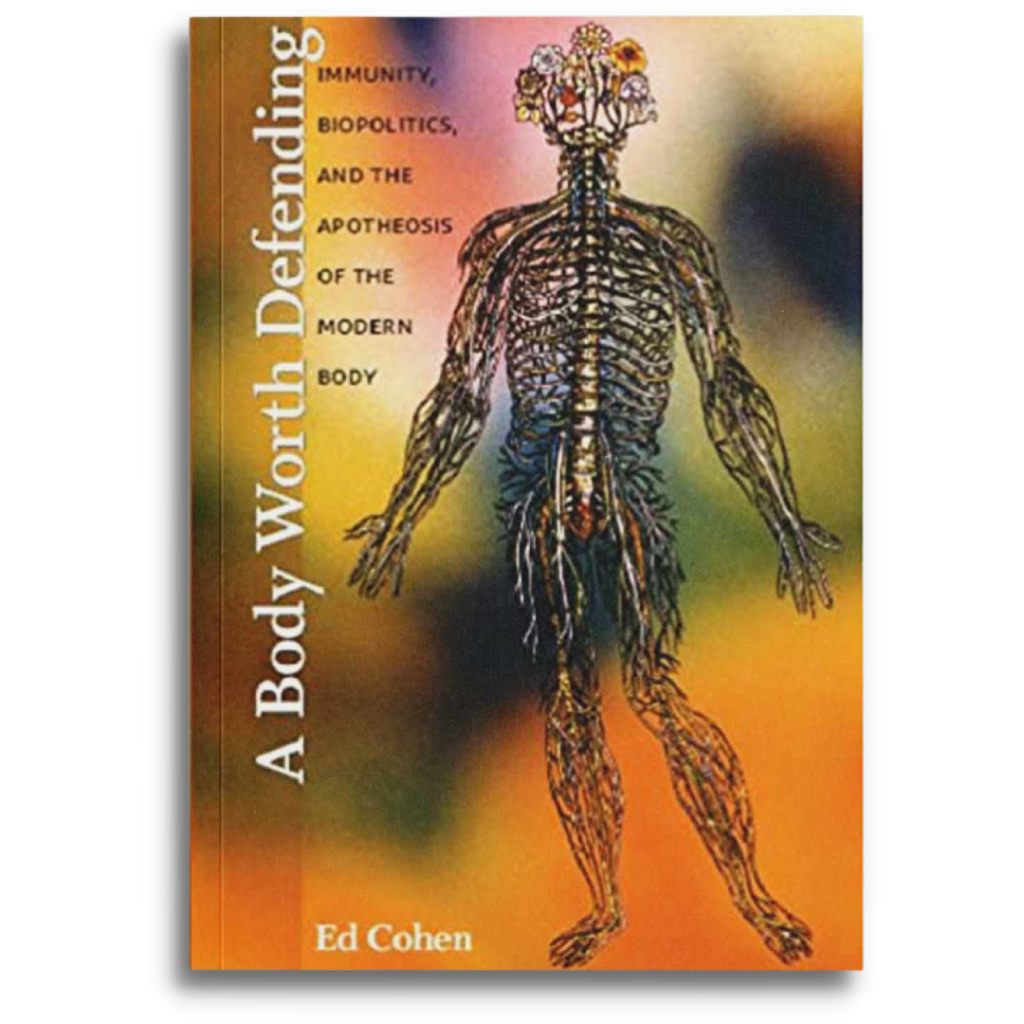
Ed Cohen – A Body Worth Defending: Immunity, Biopolitics, and the Apotheosis of the Modern Body
“What if our bodies aren’t battlefields?”
Why This Book?
Ed Cohen’s groundbreaking 2009 work reveals how Western medicine militarized the concept of “immunity”—transforming a 2,000-year-old legal principle into a biological mandate that reduced health to warfare.
Cohen also shows how biomedicine stole “defense” from legal-political realms and turned it against marginalized bodies, while denying colonized communities the right to real self-defense against systemic violence.
Core Thesis
Cohen traces how biological immunity—the idea that bodies “defend” themselves—only emerged in the 1880s.
Before that:
- Immunitas (Latin: exemption from civic duties) protected Roman elites from taxes and service.
- Hobbes reframed self-defense as a “natural right” during civil war.
- Biomedicine merged these ideas into “immunity-as-defense”—a biological warfare logic embedded deep in our cells.
Key Themes to Explore
⚖️ From Legal Privilege to Biological War
- Ancient Rome: Immunity as elite exemption.
- 17th Century: Hobbes links defense to self-preservation.
- 19th Century: Germ theory recasts bodies as fortresses and pathogens as enemies.
🏥 Hospitals as Colonial Laboratories
Cohen argues that hospitals became sites of state surveillance—mirroring imperial regimes that policed which bodies were “clean” or “contaminated.” This logic continues to shape public health systems.
🌱 The Myth of the ‘Self’-Defending Body
By naturalizing immunity as individual defense, biomedicine obscured communal healing practices. Cohen urges us to imagine biological communities—where health grows through coexistence, not combat.
Why Artist-Researchers Resonate
“My chronic illness isn’t a failure to ‘defend’—it’s a conversation between my body and the world,” one artist-researcher who lives with an auto-immune condition shared.
For patients wielding creativity against medical violence, Cohen’s book is a toolkit:
- Poets dissect metaphors that cast illness as war.
- Visual artists reimagine immunity as interdependence.
- Performance activists expose how medical language justifies exclusion.
Key Reframe
“Healing begins when we reclaim the right to define our own boundaries—and refuse to let medicine weaponize ‘defense’ to justify our dispossession.”
—Inspired by dialogues with artist-researchers surviving medical colonialism
Why This Shift Matters
This isn’t about rejecting all forms of defense.
It’s about exposing how biomedicine twisted “defense” into a tool of control that can disempower patients. It’s about expanding the evolving scientific narrative.
Countless studies show correlations between autoimmune diseases and adverse environmental conditions, like childhood adverse experience, generational trauma, domestic and long-term workplace abuse, and industrial pollution. Artistic research allows us to imagine a scientific theory in which autoimmune disease is a broken conversation between the body, the mind, and the environment, like most cultures have done for millennia.
For “colonized peoples,” meaning the global majority, boundaries aren’t abstract—they’re land, language, bodies, and traditions still under siege.
Cohen’s work reminds us: Healing demands sovereignty—a truth increasingly echoed in today’s patient empowerment movements.
What to Reflect On
Clinicians/scientists:
How does the “body-as-battleground” metaphor limit your care?
How can you redefine holistically immunity in the scientific discourse?
How do you expand to realities new to modern science, like patients, the global majority and the environment, without assimilating them into science?
How can you respect, collaborate, and re-center science around those new realities (inclusion) instead?
Pharma/Regulatory Leaders:
How does R&D’s obsession with “targeted” therapies neglect collective resilience? How can you expand your perception of patient-centered healthcare?
Policy-makers:
How can you work with clinicians, scientists, pharma and regulatory leaders, patients, advocates, and the public to support the redefinition of immunity and holistic perception of healthcare?
Patient Advocates:
What healing traditions does Western medicine erase when it privileges “immunity”?
What are the first steps to reclaim your sovereignty in the conversation between body, mind, and environment?
Public:
Who benefits the most from keeping the militarist definition of body, mind, and environment relationship when Western science reduces the latter to immunity?
How can you contribute to the scientific discourse and challenge cultural scientific constructs while respecting evidence?
Join the Dialogue
When has medicine made you feel like a “soldier” in your own body?
How might we heal beyond warfare metaphors?
Follow me on LinkedIn.
➡️ Missed Week 1 on Foucault? [Read it here]
➡️ Next Friday, Audre Lorde’s Cancer Journals—a powerful exploration of illness, identity, and healing beyond the limits of Western medicine.


3 responses to “🌿 Summer of Unlearning Series: A Reading Series for Reimagining Healthcare – Week 2 – Ed Cohen’s A Body Worth Defending – What if our bodies aren’t battlefields?”
[…] Week 2: Ed Cohen’s A Body Worth Defending […]
LikeLike
[…] Then, inspired by Foucault, Ed Cohen, a European American professor living with Crohn’s disease, powerfully unraveled medicine’s militarized myths in immunology with surgical precision in A Body Worth Defending. […]
LikeLike
[…] Friday: Ed Cohen’s A Body Worth Defending—what happens when medicine frames immunity as warfare? […]
LikeLike